















Convection Oven vs. Conventional Oven
Quick Answer: What is the difference between a convection oven and a conventional oven?
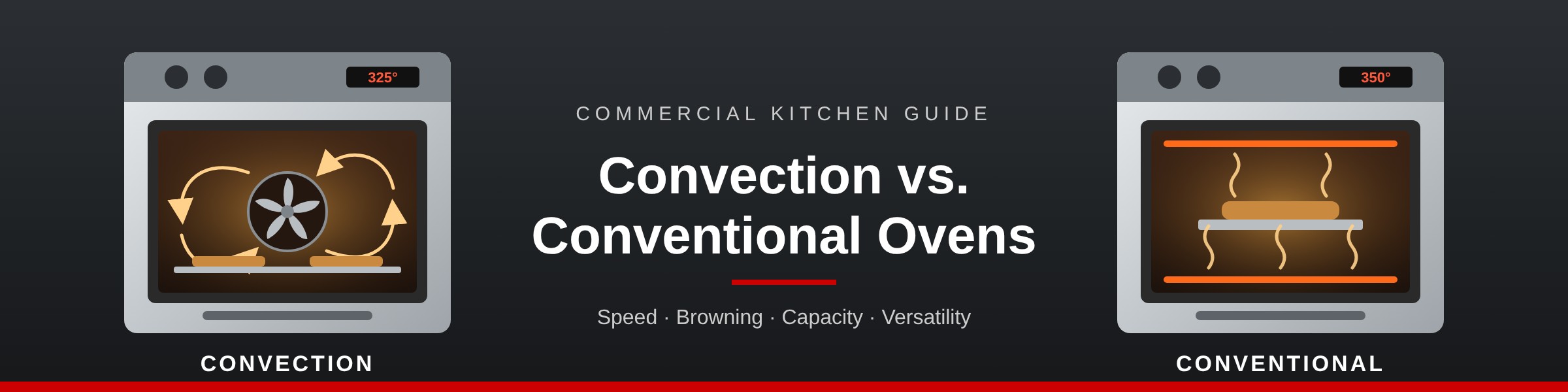
A conventional oven heats food with radiant heat from elements at the top and bottom of the cavity, so the heat sits still and cooks from the outside in. A convection oven adds a fan that circulates hot air around the food, so it cooks faster, more evenly, and usually at a temperature about 25°F lower. In a commercial kitchen, convection ovens are preferred for high-volume baking, roasting, and sheet pan cooking. Conventional ovens are better for delicate items that rise, set, or can be disturbed by moving air.
Two popular options that often confuse professional chefs are convection ovens and conventional ovens. While both serve the purpose of cooking and baking, they employ different technologies and offer distinct advantages. In this blog, we will delve into the dissimilarities between convection ovens and conventional ovens to help you understand their features and make informed decisions when it comes to your kitchen appliance choices.
Convection Oven vs. Conventional Oven at a Glance
| Feature | Conventional Oven | Convection Oven |
|---|---|---|
| How it heats | Radiant heat from top and bottom elements or burners | A fan circulates hot air throughout the cavity |
| Cooking time | Standard recipe times | Faster, often about 25% less time |
| Temperature | Standard recipe temperatures | Typically about 25°F lower |
| Heat distribution | Can have hot spots; may need pans rotated | Even heat across multiple racks |
| Browning | Strong top browning | Even browning and crisping on all sides |
| Best for | Custards, soufflés, cheesecakes, quick breads, delicate cakes | Roasted meats and vegetables, cookies, pastries, sheet pan meals, batch cooking |
| Volume | Best with one or two racks at a time | Cooks several full racks at once |
How Convection and Conventional Ovens Work
Technology and Functionality
Conventional Ovens: Conventional ovens have been a staple in kitchens for decades. They rely on radiant heat to cook food. In a conventional oven, heat is generated by heating elements located at the top and bottom of the oven. This heat rises naturally, creating a hot environment within the oven cavity. The food absorbs heat from the surrounding air, gradually cooking from the outside to the center.
Convection Ovens: Convection ovens, on the other hand, are equipped with an additional component known as a fan. The fan circulates the heated air evenly throughout the oven cavity. This creates a consistent temperature and speeds up the cooking process. The hot air blowing onto the food helps to cook it more rapidly and evenly, resulting in faster cooking times and often more even browning.
Cooking Time and Temperature
Conventional Ovens: Conventional ovens tend to have longer cooking times compared to convection ovens. Since the heat rises from the bottom and top, it takes time for the food to cook evenly. Additionally, conventional ovens may require higher temperatures for certain recipes. However, they can provide a more traditional cooking experience and are well-suited for recipes that require slower and more precise cooking, such as baking delicate pastries or slow-roasting meats.
Convection Ovens: Convection ovens offer a significant advantage in terms of cooking time. The circulation of hot air ensures that the food cooks faster and more evenly. Due to the improved heat distribution, convection ovens can generally operate at lower temperatures than conventional ovens while achieving the same results. The decreased cooking time can be especially beneficial for busy cooks who want to prepare meals quickly without compromising on quality.
How to Convert a Recipe for a Convection Oven
Most recipes are written for conventional ovens. To adapt one for a convection oven, use this general rule of thumb:
- Lower the temperature by about 25°F. For example, a recipe that calls for 350°F would run at about 325°F in a convection oven.
- Check for doneness early. Start checking at about three-quarters of the original cook time.
- Use low-sided pans. Sheet pans and shallow hotel pans let the air reach the food. Tall sides block airflow.
- Leave space between pans. Overcrowding blocks the air and creates uneven results.
Many commercial convection ovens also have a low or variable fan speed setting for lighter items like cakes and meringues. Always check your manufacturer’s guidelines.
Which Oven Is Better for Baking and Browning?
Baking and Browning
Conventional Ovens: Conventional ovens excel at producing a desirable browning effect on the top of dishes. Since the heat originates from the top, this type of oven is ideal for recipes that require a golden or crispy crust, such as casseroles, gratins, or roasted vegetables. However, the browning may be less even throughout the dish due to the uneven heat distribution.
Convection Ovens: Convection ovens, with their uniform heat distribution, are excellent for achieving even browning on all sides of the food. The circulated hot air ensures that the moisture on the surface of the food evaporates quickly, resulting in a crisp exterior. Baked goods, such as cookies and pastries, also benefit from the even heat distribution, leading to consistent browning and uniform texture.
When to Use a Conventional Oven Instead
Moving air isn’t always an advantage. Batters and delicate items can set unevenly, dry out, or lean to one side in a strong fan. Many bakers prefer conventional heat (or a convection oven with the fan turned down or off) for:
- Custards, crème brûlée, and cheesecakes baked in a water bath
- Soufflés and other items that need to rise without disruption
- Quick breads and some layer cakes
- Meringues and light, airy batters
Versatility: Which Oven Does More?
Adaptability and Versatility
Conventional Ovens: Conventional ovens offer simplicity and familiarity. They are generally straightforward to operate, making them suitable for individuals who prefer a more traditional cooking experience. Conventional ovens are compatible with almost all types of cookware and are well-suited for a wide range of cooking methods, including baking, broiling, and roasting.
Convection Ovens: Convection ovens provide greater versatility. In addition to the standard cooking methods, the even heat distribution and reduced cooking times make them ideal for multiple cooking techniques, including dehydration, defrosting, and even air frying (when equipped with specific features). However, it's worth noting that some delicate recipes may require adjustments to account for the faster cooking times and improved heat distribution.
Types of Commercial Convection Ovens
For foodservice operations, convection ovens come in several configurations. The right one depends on your volume, menu, and available space.
- Full-size convection ovens: These hold standard full-size sheet pans and are the workhorse of restaurant, school, and institutional kitchens. Examples include the Blodgett DFG-100 single gas convection oven and the Equipex FC-100 full size convection oven.
- Double deck convection ovens: Two ovens are stacked in the footprint of one, which doubles capacity for high-volume kitchens. See the Vulcan VC44ED double deck electric, the Blodgett Zephaire ZEPH-200-E double, or shop all double deck convection ovens.
- Countertop convection ovens: These use half-size pans and fit on a counter. They work well for cafés, concessions, satellite kitchens, and grab-and-go baking. Popular models include the Cadco OV-003, the Waring WCO500X, and the Equipex FC-60. Shop all countertop convection ovens.
- Combi ovens: These combine convection heat with steam, so one unit can roast, steam, bake, and rethermalize. Examples include the Blodgett BLCT-62-62E combi oven steamer and the Convotherm line.
- High-speed ovens: These combine convection with microwave energy for very fast cook times, as in the TurboChef ECO high speed convection/microwave oven.
Gas vs. Electric Convection Ovens
Commercial convection ovens are available in both gas and electric models. Gas ovens usually heat up quickly and can cost less to run where natural gas is inexpensive. Electric ovens are often easier to install and hold temperature very consistently. Your choice usually comes down to the utilities available in your kitchen, local energy costs, and your ventilation requirements. ENERGY STAR® certified models can also help lower operating costs.
Choosing the Right Oven for Your Kitchen
CHOOSING BETWEEN THE TWO
The choice between a convection oven and a conventional oven ultimately depends on your cooking preferences and needs. Conventional ovens excel at delivering traditional cooking results with reliable browning, while convection ovens offer faster, more even cooking. By understanding the differences outlined in this blog, you can make an informed decision that aligns with your culinary aspirations and elevates your cooking endeavors to new heights.
For most commercial kitchens, a convection oven is the more productive choice. It can cook several full racks at once with even results and shorter cook times. Many operations keep both: convection ovens for volume roasting and baking, and conventional range ovens or deck ovens for delicate baked goods and specialty items.
Frequently Asked Questions
Is a convection oven better than a conventional oven?
For most high-volume commercial cooking, yes. A convection oven cooks faster and more evenly, and it can handle multiple racks at once. A conventional oven is still the better choice for delicate items such as custards, soufflés, and some cakes, where moving air can cause uneven rising or drying.
How much faster is a convection oven?
A convection oven typically cooks about 25% faster than a conventional oven. Actual times depend on the food, the pan, how full the oven is, and the model.
Do you lower the temperature in a convection oven?
Yes. A good rule of thumb is to lower the temperature by about 25°F from what a conventional recipe calls for. Start checking for doneness at about three-quarters of the original cook time.
What should you not cook in a convection oven?
Avoid strong convection for delicate batters and items that need to rise or set gently, such as soufflés, custards, cheesecakes, quick breads, and some cakes. If your convection oven has a low fan speed or fan-off setting, use it for these items.
What kind of pans work best in a convection oven?
Low-sided pans, such as aluminum sheet pans and shallow hotel pans, work best because they let hot air move across the food. Leave space between pans so the air can circulate.
Shop Commercial Convection Ovens at Cook’s
Cook’s carries full-size, double deck, countertop, and combi convection ovens from trusted brands including Vulcan, Blodgett, Garland, Southbend, Hobart, Cadco, Equipex, Waring, and Alto-Shaam. Shop all commercial convection ovens or browse our full selection of commercial cooking equipment.
Need help choosing the right oven for your operation? Call our team at 866-613-2617.

